|
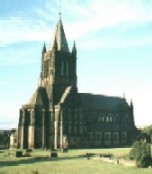
St. Bartholomew's, Armley BRIEF HISTORY OF THE ORGAN |
|
|
St. Bartholomew's, Armley BRIEF HISTORY OF THE ORGAN |
|
Written with much reference to The Armley Schulze Organ by Kenneth I. Johnstone no longer available
|
|
|
|
|
|
|
Edmund,
and later his brother Eduard, Schulze will have become pretty
familiar with Yorkshire in
their time. They must also have regretted not fitting their
organs with castors, considering the way their famous instrument
which finished up at St.Bartholomew's, Armley, has moved around
during its lifetime. A
note of freight charges, dated 28th September, 1868
, and
advice of despatch via the North Eastern Railway Company from
Hull Docks, was sent to Mr. T. S. Kennedy at Wellington Foundry,
Leeds, byMessrs. Gee & Co., Forwarding Agents for Goods to
and from Hamburg. Seventy-six packages, totalling 824
feet in length @ 2d +10%, attracted charges of £7.11.1d,
plus Charges paid per Bill of Loading (£16.18s.9d) and
extras, including Dock Charges for Off-loading, etc.,
Cartage and Commission, of £2.5s.0d.The consignment, only
one of several, was described as 'Parts for an Organ' - an Organ
that was to become famous throughout the musical world. |
|
|
|
|
Thomas
Stuart Kennedy had
his house at Meanwood,
then
on the outskirts of Leeds, designed and built in 1866, in an
ostentatious style, which we might today describe as impressive,
but outstandingly ugly. It exists to this day, minus its
extraordinary tall chimney stacks, as Meanwood
Towers.
Some 40 yards from the front door he added an 'organ house',
sometimes described as a 'summer house' in which he had Edmund
Schulze install the Organ he had commissioned from the Schulze
family firm based in Paulinzelle
(now
Paulinzella), Germany. Perhaps it is worthwhile
pausing to put together a picture of a person able, at the age of
25, to have an extravagant mansion built for himself, together
with a large organ house. |
(Back
home he became a highly respected Justice of the Peace.)
|
|
Sadly, a few years after the Organ's installation, Mrs. Kennedy became chronically ill, and could no longer use the instrument; it was therefore put up for sale. Two sisters, the Misses Carter of Harrogate, stepped in and purchased the Organ, loaning it to their church of St.Peter's, where Edmund Schulze again supervised the installation. The reason for this loan arrangement is unknown, but the apparently disagreeable nature of the Vicar may well hint at an answer. Before very long he approached the ladies with an ultimatum to either present the Organ outright, or remove it - a most original way indeed of saying "Thank you"! They responded by having it taken out, which must have taught at least one Victorian cleric a thing or two about girl power. The ladies obviously had no quarrel with the Church of St. Peter itself, for the Carter family commissioned a smaller replacement from the ubiquitous Edmund, which turned out to be the last organ he was to build. It was admitted afterwards that the first Schulze instrument had not sounded well where it was, the church being two small for its power. |
St.
Peter's may not be of the gargantuan proportions of |
|
|
|
|
|
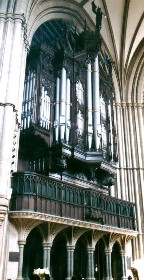
Just
as the famous bell known as Big Ben is visualised as a four-faced
clock tower, the casual observer will take away an image of the
Armley Schulze as being a few pipes (from the new
Pedal Open Metal 16') set in an imposing ornate case. This
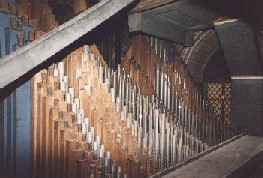
unwittingly ignores the five organs within, and the remaining
3,600 pipes that are hidden behind the screen. Certainly the case
is magnificent, especially in comparison with the apparent chaos
of the Organ's innards. There is the slightest of doubts
concerning the identity of the case's designers, generally
credited to be Messrs. Walker and Athron, the architects of the
Church itself. In common with much of the adjacent woodwork, it
is made up in American walnut, and blends perfectly with the
lines of the building. |
|
|
Carved
panels depict ornithologically dubious singing birds amongst
branches of prolific oaks, these intricate carvings being carried
down to hidden cupboards towards the rear of the supporting
vaulted stone gallery of arches. These panels are echoed right at
the top of the case, out of sight without the aid of
scaffolding. Recent investigations have led us to the
conclusion that these designs are the work of William Morris,
though we have no actual proof. The two panels mentioned
are very much in his style, and he registered almost identical
designs two years before the case was installed and one year
after. Morris’s great collaborator, Burne-Jones, was part
of the Gilbert Scott group. Scott, the architect of the
Albert Memorial, was an admirer of the church, and Athron, the
architect and joint designer of the case, was his pupil. It
is difficult to dismiss some collaboration, if only through a
London gentlemen’s
club, sketching on an envelope! |
of powering the Organ's hydraulic motor, and a gas engine was installed. Though effective, the exhaust from this contraption was noted to cause considerable deterioration to the more vulnerable parts of the instrument, such as the leather bellows. History records this in detail, and only mentions in passing that a number of the congregation could regularly be relied upon to demonstrate immediate deterioration by passing out during services because of the fumes! Improvements in the town water supply in 1873 allowed a return of the hydraulic motor system, along with the redundancy of the Organist, Tom Cawthra's, young son who had spent many Sunday hours in the engine room with a lit taper in case the gas went out. In 1911, the wonder of electricity led to an electric powered motor that performed well until 1956, when it expired with a strong smell of burning. Its replacement is still working to this day, looking alarmingly lonesome in the large purpose-built pump room. Cleaning programmes in 1899 and 1900 were used as an excuse for the only serious bit of alteration to the original Schulze specification, replacing a full rank of pipes (the Swell Rohrflõte 8ft.) with a Celeste rank (but without changing it's stop label!). In 1905 a major overhaul saw the increasingly erratic pneumatic lever action replaced by tubular pneumatics, allowing a quieter operation altogether. |
|
|
|
|
|
|
|
|
|
|
Every
time major works have been completed over the years, a grand
re-opening has been necessary, and the 10th of March, 1956 was no
exception. Francis Jackson officiated, and the recital was
broadcast live, which was a pity, since what came out was not
quite what Dr. Jackson put in, due to a sound technician, who,
moments before the programme started, dislodged a large plank
above the Organ, which dropped squarely across many ranks of the
Great. Several pipes needed replacement and many more were
dislodged leading to most un-musical noises during the broadcast.
Further tragedy occurred in 1964 when the church was internally
steam cleaned - a popular pursuit of the time, and in this case
greatly effective. However, experts knew better than John
Watkins, and the Organ was only partly protected. Most timber
components suffered badly as a result, with drawstop rods
swelling and jamming, and soundboards twisting out of shape.
Apart from this, the resulting savage humidity did no favours to
the leatherwork of the bellows. A great deal of metal corrosion
followed, along with damage to the ivories. It was mainly due to
the Organist and the diligence of Tom Jackson, the organ's
maintenance contractor, that emergency restoration over several
months was successful. |
Organ
was launched in 1974, and which, thanks to an enormous legacy
allowed the 2002/4 major restoration to take place. Over the last
40 years, annual concert series' have been well attended, and
various recordings have brought the instrument to a world-wide
audience. The
question arises as to the importance of the Armley Schulze
Organ. First and foremost is its position in historical
heritage, being aunique example of the unspoilt work of the
Schulze family in Britain .
Beyond that, there are many practical values that set it apart.
Quoting from Kenneth I.Johnstone's
book,
'The Armley Schulze Organ', the instrument |
|
|
|
|
Comprehensive
and finely detailed listings of the Organ's
specifications throughout its life are detailed in "The
Armley Schulze Organ"
by Kenneth Johnstone, now out of print.
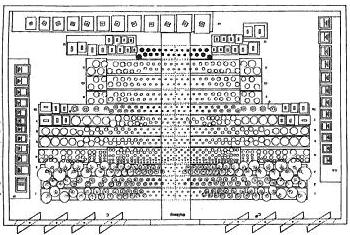
For
detailed plans of the layout of the organ, see Echo Organ 1.
Lieblich Bordun 16ft. Choir
Organ Swell Organ 1.
Bordun 16ft. 1.
Sub Principal 16ft. Pedal
Organ
Couplers
Meanwood
|
|
|
|
|
|
|
The
Swell Rohr Flöte
was
replaced with a Cèleste,
probably by Abbott & Smith around 1900, |
|
|
|
|
|
|
|
|
|
|
|
|
|
|
|
Swell
to Great |
Great
to Pedal |
Echo
to Choir |
Echo
to Swell |
|
|
|
|
|
ACCESSORIES
(2003) Six foot pistons to the Pedal Organ Four pistons each to the Choir and Echo Organs Six pistons each to the Great and Swell Organs Reversible pistons: Great to Pedal, Swell to Pedal, Swell to Great Reversible foot pistons: Great to Pedal, Swell to Pedal Sequencer, operating general pistons Piston couplers: Great
and Pedal pistons; Generals on Pedal foot pistons Balanced expression pedal to the Swell Organ
|
1851 |
|
J. F.
Schulze & Sons invited to provide an organ for the |
1858 |
|
Death of J. F Schulze - Edmund, the eldest son, takes over. |
1866 |
|
T .S. Kennedy commissions designs for Meanwood Towers . While touring in Switzerland , Kennedy detours to visit the famous Schulze workshops in Paulinzelle, from where he eventually commissions a small house organ for his new home. |
1867 |
|
Proposals for the organ grow in size, necessitating the building of a separate organ house. |
1869 |
|
7th May, Completion of organ house. |
|
|
20th July, Last load of organ parts despatched. Edmund Schulze takes up residence at Meanwood. |
|
|
Organ opened with a private recital by S. S. Wesley. |
1877 |
|
16th
August, Organ inaugurated in St. Peter's, Harrogate ,
after Kennedy was obliged |
|
|
24th August, Consecration of the new church of St. Bartholomew ’s, Armley. |
1878 |
|
Death of Edmund Schulze. |
1879 |
|
Organ removed from St. Peter's following dispute with the vicar. Smaller replacement is ordered from J. F. Schulze & Sons, and opened on 28th June. |
|
|
Organ enlarged by Eduard
Schulze and installed in St. Bartholomew's, Armley, |
|
|
Firm of J.F. Schulze wound up. |
1880 |
|
Death of Eduard Schulze. |
1905 |
|
Major rebuild by James Jepson Binns. |
1956 |
|
Renovation programme instituted. |
1974 |
|
Restoration appeal launched. |
1990 |
|
Gala Concert. |
1991 |
|
Bequest received from Luker Trust of £400,000 |
2004 |
|
Complete restoration and re-ordering. |
|
If you are a tax-payer, and wish to
donate through Gift Aid, I am a tax-payer, and wish to make my donation through Gift Aid. To donate
on-line: for further information, see email on homepage Organist, Graham Barber: http://www.grahambarber.org.uk For stunning
pictures of the church, tower & organ, by
Phill: |
|